How an ERRCS project runs
The ERRCS project, step by step
Every firefighter radio coverage project runs in the same order: check the rule, measure the signal, design and get approvals, install and pass the acceptance test, then test every year. Here is each step with who does it, the paper it produces, the time the rules allow and the usual ways it goes wrong.
The five steps at a glance
| Step | Who does it | What it produces | Time the rules set |
|---|---|---|---|
| 1. Check the rule | Owner, board or manager; the fire marshal decides | A written answer with the code section, or the fire marshal's letter | Not published; a Florida retrofit order allows at least 1 year from the notice (F.S. 633.202(18)(g)) |
| 2. Measure the signal | Radio tester or designer; in Miami-Dade, MDFR runs a pre-test first | A floor-by-floor coverage grid report | MDFR emails pre-test results within two business days (MDFR guidelines); survey length not published |
| 3. Design, consent and permit | RF designer, the radio licensee, the fire department; the FCC for Class B registration | Approved plans, the licensee's written consent, the permit, the FCC booster ID | Not published; ask each bidder for a written schedule |
| 4. Install and acceptance test | Installer and whoever runs power and pathways; the fire department witnesses the test | The acceptance test report with the amplifier gain values, a closed permit | Not published |
| 5. Test it every year | The owner hires a qualified tester; the report goes to the fire department | An annual test report | Every year and after structural changes (IFC 2021 510.6.1) |
Where a time is "not published", no code or fire department document we have read sets one. A bidder's schedule is a promise, not a rule, so get it in writing.
Step 1: Check the rule
Who: the owner, board or manager asks; the fire marshal (the authority having jurisdiction, AHJ) decides.
The fire code requires approved radio coverage for emergency responders inside the building (IFC 2021 510.1). In Florida the rule is also in state law, F.S. 633.202(18), which exempts some buildings outright (F.S. 633.202(18)(h)) and requires no system or assessment where the fire marshal finds the public safety signal weak even outside (F.S. 633.202(18)(e)).
- What it produces: a written answer you can show the board, with the code section behind it. Our building checker applies every published exemption for the places we cover and cites each one; the requirements pages list local rules.
- What can go wrong: assuming the building is exempt without asking in writing. Florida's statute says "apartments"; condominium buildings are normally classed as apartment occupancies, but confirm with your fire marshal.
Step 2: Measure the signal
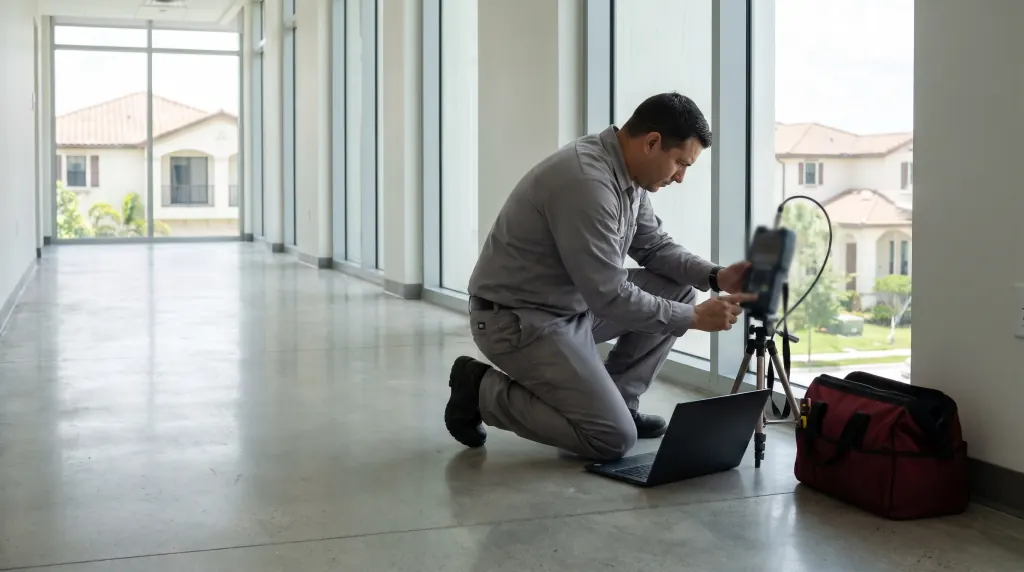
Who: a radio tester or the system designer. In Miami-Dade, MDFR or county staff run a pre-test inspection (Phase I) with a calibrated spectrum analyzer and handheld voice tests, and email the results within two business days (MDFR guidelines).
You cannot size a fix without measuring floor by floor. The model code tests each floor as a grid of 20 areas (IFC 2021 510.5.4) and sets the bar at coverage in 95 percent of all areas and 99 percent of critical areas (IFC 2021 510.4.1). Miami-Dade uses 90 percent of general areas and 99 percent of critical areas, and tests both its 450 MHz and 800 MHz systems (MDFR guidelines). Some cities require a test before any amplifier is designed; Houston is one (Houston CE-1350).
- What it produces: a written report with a coverage grid for every floor. If the building passes, no amplification system is required (IFC 2021 510.4.2.1).
- What can go wrong: a quote with no test report behind it; a test run on the wrong frequencies. The fire code official keeps a document with the frequencies and design details (IFC 2021 510.4.2.2), so ask for it first.
How coverage is tested
One floor, 20 squares, a radio check in each
- 20 test areas per floorEach floor is divided into a grid of 20 roughly equal areas.IFC 2021 510.5.4
- One test spot per areaA spot near the center stands for the whole area. No extra spots after it is chosen.
- One failed area is allowedMore than one failed area fails the floor. With exactly two, the floor may be re-divided into 40 areas, and up to two non-adjacent failures are allowed.IFC 2021 510.5.4
- Critical areas count moreTypical model-code targets: 95 percent of all areas and 99 percent of critical areas such as stairs and elevator lobbies. Your fire marshal sets the numbers that apply to you.IFC 2021 510.4.1
Illustration: 19 of 20 areas pass, so this floor passes. Some fire departments use other numbers; Miami-Dade, for example, stops an acceptance test below 90 percent of general areas.
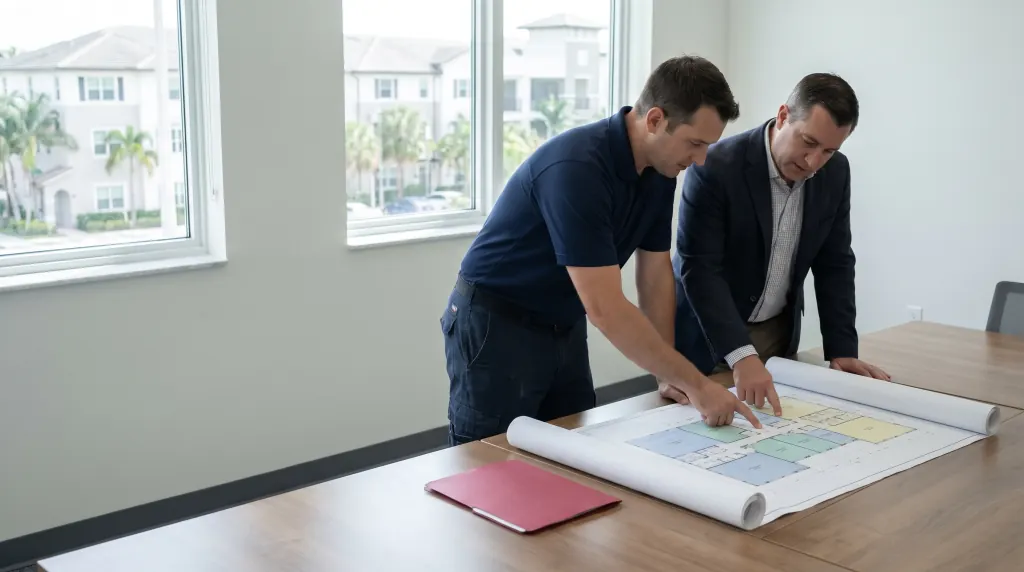
Step 3: Design, consent and permit
Who: an RF designer, the radio licensee (usually the city, county or regional radio system), the fire department, and for Class B boosters, the FCC.
- Design. At a minimum the designer and lead installer need an FCC general radio operator license and in-building system training (IFC 2021 510.5.3). Some cities add a licensed engineer's seal; Houston requires a Texas PE (Houston CE-1350).
- Licensee consent. A booster may only operate with the express consent of the frequency licensee, kept in a recordable format (47 CFR 90.219(b)(1)(i)). Florida requires the licensee's express consent for any new system or change to an existing one (F.S. 633.202(18)(d)). Our sister site explains licensee consent and FCC registration.
- Permit. A construction permit is required to install or modify a system (IFC 2021 510.3). In Miami-Dade, the BDA permit (category 0040) follows a failed pre-test, and no radio equipment may be installed before plans are approved (MDFR guidelines).
- FCC registration. Class B signal boosters must be registered (47 CFR 90.219(d)(5)), and a new one must be registered before it operates (FCC DA 14-15).
- What it produces: approved plans, the licensee's written consent, the permit, and the FCC confirmation with a booster ID.
- What can go wrong: equipment bought or installed before approval; a missing consent letter, which can stop the acceptance test.
Step 4: Install and pass the acceptance test
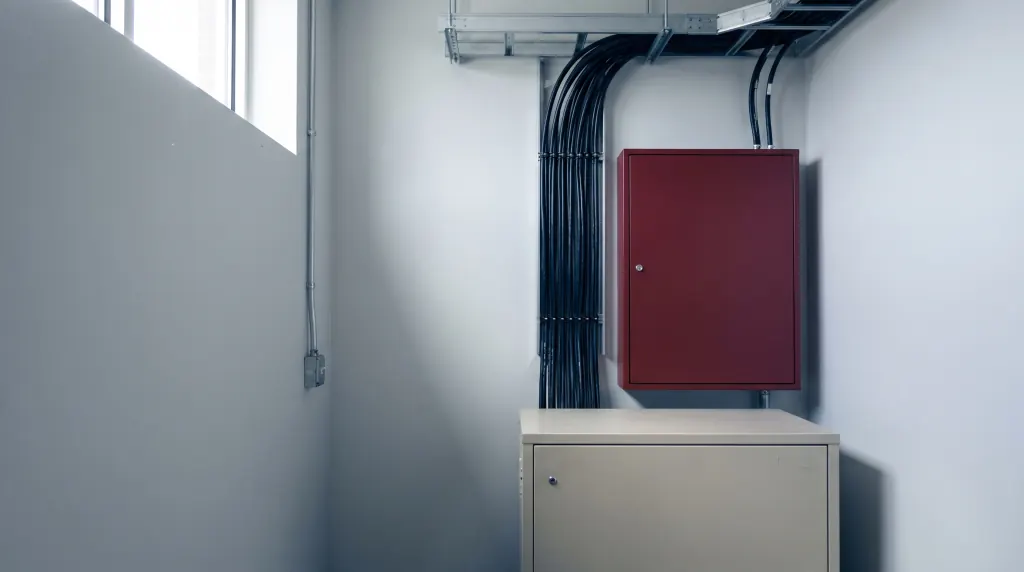
Who: the installer, whoever runs power and pathways (the fire code does not say whether that is the installer or a separate electrical contractor, so ask each bidder and check it is in the price), and the fire department, which witnesses the acceptance test.
The system needs standby power for at least 12 hours at full load under the model code (IFC 2021 510.4.2.3), and it is tested floor by floor when it goes in (IFC 2021 510.5.4). In Miami-Dade the acceptance test (Phase II) needs the permit number, commissioning documents and separate 450 MHz and 800 MHz grid maps, the installer must be there, and the fire alarm test follows before the permit closes (MDFR guidelines).
- What it produces: the acceptance test report and the amplifier gain values. Keep them: if they are lost, the owner must rerun the acceptance test (IFC 2021 510.5.4 item 6).
- What can go wrong: missing the coverage percentages (Miami-Dade stops the test if coverage misses 99 percent of critical areas or 90 percent of general areas); locked rooms on test day. Each re-inspection costs money: in Miami-Dade, $98.46 for the first or second and $194.44 for a third or later, and "no contractor or unable to gain access on inspector's arrival" is one of the listed reasons (Implementing Order 04-123). Add up your fire department's fees with the fee estimator.
Step 5: Test it every year
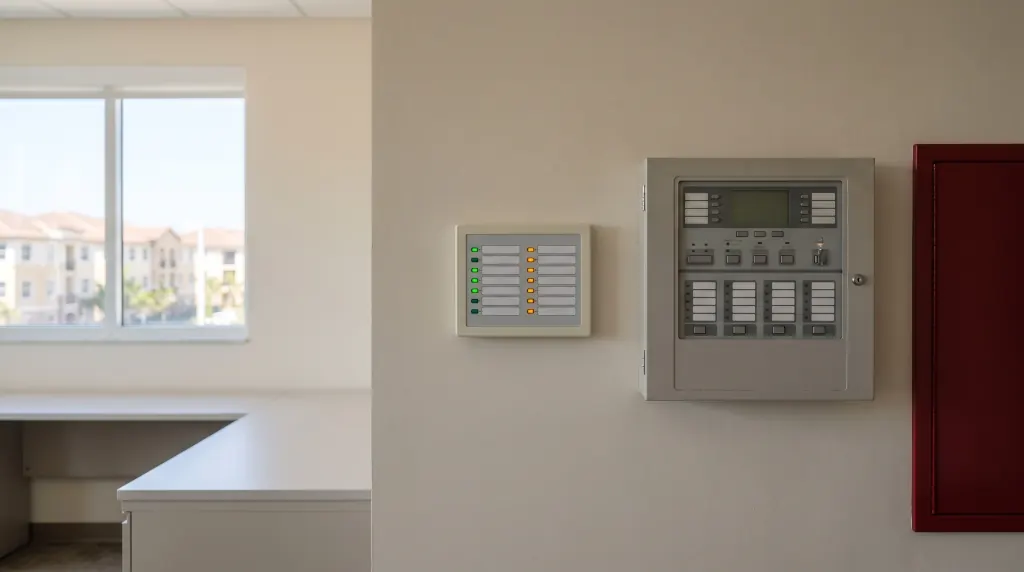
Who: the owner hires a qualified tester; the report goes to the fire code official (IFC 2021 510.6.1).
The model code requires a test every year and whenever structural changes could change coverage (IFC 2021 510.6.1). In Florida the fire marshal may also require a new coverage assessment no more than once every 3 years for a high-rise or a building over 12,000 square feet, and once every 5 years for others, with exceptions (F.S. 633.202(18)(c)2). We have not found a separate five-year test in IFC 510 or the Florida statute; if your fire department wants one, it will be in its own requirements. Miami-Dade also requires a service contract with a licensed radio service provider whose runner responds within four hours of a trouble signal (Sec. 14-69, Code of Miami-Dade County, quoted in the MDFR guidelines).
- What it produces: an annual test report, sent to the fire department.
- What can go wrong: a missed year, batteries that fail the load test, and renovations (new windows or walls) that change the signal. Our sister site BDACheck has the tools for this step: BDA testing works out when your next test is due and walks you through test day, and the failure finder points to the likely cause when a test fails.
Where to go from here
- Just got a notice? Start with Got a notice? or what to do after a citation.
- On a condo board? ERRCS for condo boards explains it in plain words, the cost per owner calculator splits a quote, and if a building recertification or milestone inspection is coming, plan them together.
- Ready for prices? Request up to 3 quotes. Your request goes to up to 3 vetted installers who serve your area. We send no texts and make no cold calls, and owners never pay us.
This is guidance, not legal or engineering advice. Confirm every step with your fire marshal (AHJ).
Next step
Take the board a plan, not just a problem
Ask for up to 3 quotes from vetted installers who serve your area, or start with a one-page brief the board can read before the next meeting. Free for owners, boards and managers. No texts, no cold calls.
Questions people ask
How long does an ERRCS project take from start to finish?
No code or fire department document we have read publishes a typical project length. The dates that are published are deadlines: in Florida, a building the fire marshal cites after the statutory dates gets at least 1 year from the notice of code violation to finish a required retrofit (F.S. 633.202(18)(g)). Ask every bidder for a written schedule that covers the test, design, approvals, install and the acceptance test.
Who is responsible if the system fails the acceptance test?
The code puts the obligation on the building owner (IFC 2021 510.5.4 and 510.6.1). Who pays to fix and retest is a question for your contract with the installer, so ask before you sign. Fire department re-inspection fees are set locally; Miami-Dade, for example, charges $98.46 for a first or second re-inspection and $194.44 for a third or later one (Implementing Order 04-123).
Is there a five-year test as well as the annual one?
Not in the texts we cite. IFC 2021 510.6.1 calls for an annual test and a test after structural changes, and Florida lets the fire marshal require a new coverage assessment no more than every 3 or 5 years, depending on the building (F.S. 633.202(18)(c)2). If your fire department asks for a five-year test, it will say so in its own requirements; confirm with the fire marshal.
Sources
Primary documents we read for this page. Rules change; confirm with your fire marshal (AHJ).
- Florida Statutes 2026, section 633.202, subsection (18), The Florida Senate
- International Fire Code 2021, Section 510 (text as published by the City of Eaton), City of Eaton, reproducing the ICC International Fire Code
- General Guidelines for the Deployment of Two-Way Radio Communication Enhancement System (BDAs), Miami-Dade Fire Rescue
- 47 CFR 90.219, Use of signal boosters, Electronic Code of Federal Regulations
- DA 14-15: Wireless Telecommunications Bureau Announces Availability of Part 90 Class B Signal Booster Registration Tool (Jan. 7, 2014), Federal Communications Commission
- Emergency Responder Communication Coverage (ERCC) Guideline, Form CE-1350 (revised July 2025), City of Houston
- Implementing Order 04-123: Miami-Dade County Fire Prevention Fee Schedule (effective 10/01/2025), Miami-Dade County
Related
Your building got an ERRCS notice. Here is what it means.
ERRCS in plain English for condo owners and boards: why firefighters need it, the Florida deadlines, reported costs, and what to bring to your next board meeting.
An ERRCS notice landed on your desk. Here is your first week.
For property and community association managers: what to do in the first week after an ERRCS notice, how to brief the board, compare bids, budget and stay compliant.
You got a fire marshal notice about radio coverage. Now what?
A step-by-step plan for owners and managers after an ERRCS or BDA notice of violation: read the deadline, test, hire qualified help, get consent and permits.
What will the ERRCS work cost each owner?
Split an ERRCS or BDA project cost across the owners, with optional reserve money and published fire department fees. Sourced figures only, estimate only.